- Executive Resilience Insider
- Posts
- When Six Executives Claim AI Ownership, Nobody Decides
When Six Executives Claim AI Ownership, Nobody Decides
A Fortune 500 company needed six months and a new C-suite role to resolve what clear governance solves in a week

Mario Peshev
March 17, 2026
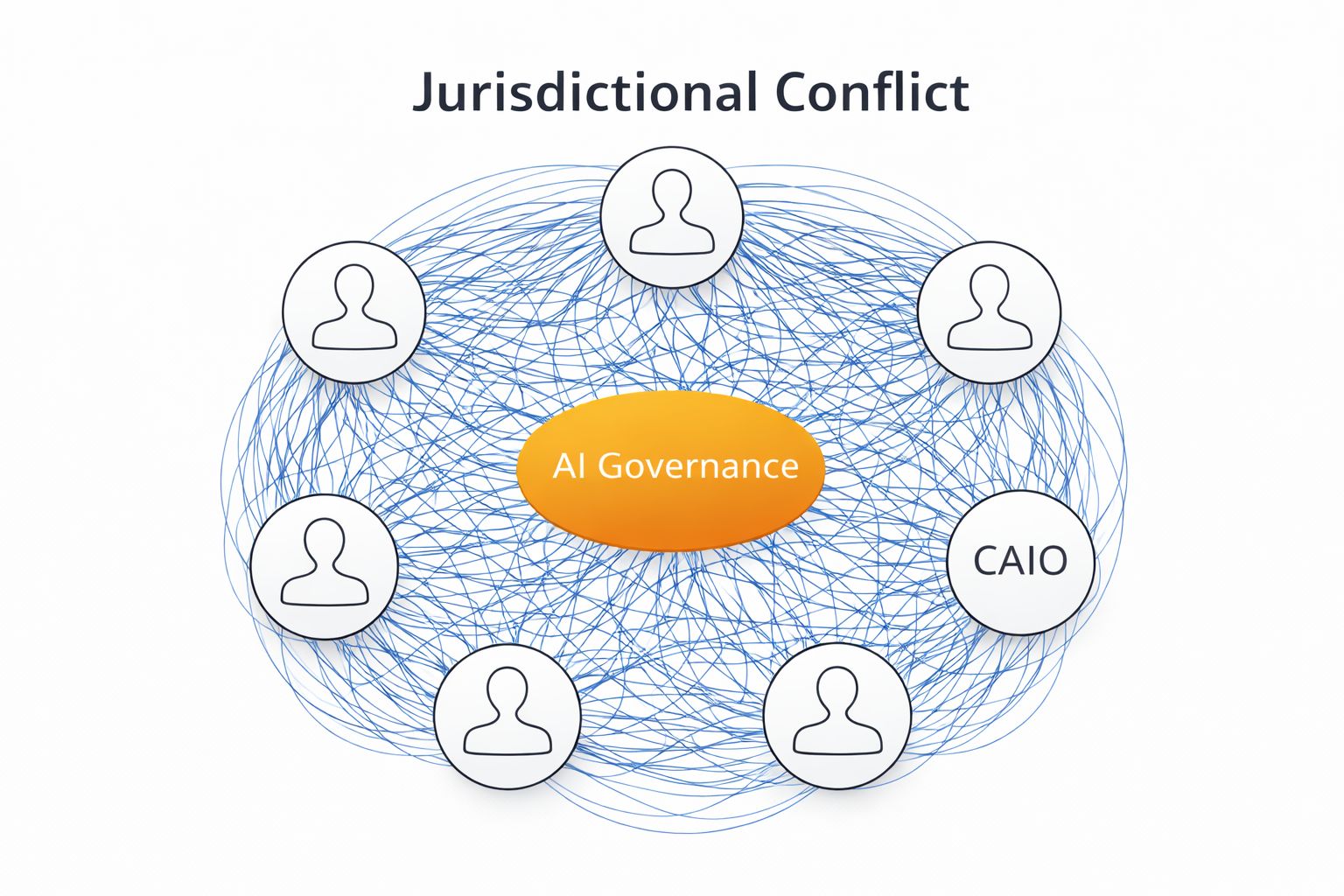
An insurance company couldn't decide who owned AI strategy. Six executives claimed jurisdiction.
The solution? The creation of a Chief AI Officer role to resolve the impasse.
The result? A systematic dysfunction: organizations respond to coordination failure by adding coordination layers.
Why Professional Jurisdiction Theory Predicts AI Governance Failure
Andrew Abbott's 1988 framework on professional jurisdiction explains why AI ownership debates paralyze executive teams.
Professions exist in perpetual competition over work domains. Technology disruptions redraw these boundaries.
AI triggers the most aggressive jurisdictional contest since enterprise software emerged in the 1990s.
The insurance company's six-executive stalemate reveals the mechanism. Each leader possessed legitimate claims to AI authority:
The CIO controlled the infrastructure.
The COO managed operational deployment.
The CFO owned the P&L impact.
The Chief Risk Officer governed autonomous decision exposure.
The CHRO managed workforce implications.
The Chief Data Officer controlled the permissions architecture.
Six valid jurisdictions created decision paralysis.
Historical precedent confirms the pattern.
Nurse practitioners absorbed primary care tasks from general practitioners. CPAs and tax lawyers compete over complex tax planning. Social workers, psychologists, and psychiatrists contested mental health treatment domains.
These jurisdictional battles lasted decades. Organizations cannot afford decade-long AI ownership debates while competitors establish implementation velocity.
The CAIO role doesn't resolve jurisdictional conflict - it institutionalizes it.
Creating a new executive position adds a seventh competitor to the existing six.
Dell, Pfizer, PwC, UBS, and Expedia adopted this structure. None published evidence that CAIOs accelerated AI deployment or clarified decision authority.
The role signals AI's importance to external stakeholders while preserving internal power distribution. Governance theater replaces implementation architecture.
The Equation: Leadership additions ↑ = Implementation velocity ↓
Why frictionless best practices destroy governance capacity
AI governance paralysis stems from a search space collapse mechanism documented in organizational learning research.
When executives face novel technology decisions, they choose between two costly strategies: independent exploration, requiring deep investigation, or knowledge reuse, borrowing from existing frameworks.
The Management Science model reveals the trap.
As reuse becomes frictionless - through consultants, peer benchmarking, or CAIO role templates - exploration effort drops precipitously. Teams converge on identical governance structures regardless of context.
The 847 CAIO appointments represent systematic convergence, not strategic thinking. Executives facing AI uncertainty default to the visible solution: hire the role everyone else created.
Independent exploration - analyzing actual AI workflow integration, measuring decision bottleneck locations, mapping authority conflicts - costs weeks of executive attention.
Copying competitor organizational charts costs one recruiter call.
Boudreau and Lakhani's 2015 field experiment with computational biologists demonstrated the mechanism precisely. When researchers gained frictionless access to peer solutions, effort shifted toward refining existing approaches.
The search space narrowed. Fewer people explored independently. Productivity increased while innovation flattened.
CAIO role proliferation follows identical dynamics.
Early adopters explored governance models through painful trial. Later adopters reused those templates without understanding the context that shaped them.
Each reuse cycle reduced exploration further. By appointment 847, organizations were copying copies of copies - governance structures divorced from the operational realities they supposedly address.
The systematic dysfunction isn't the CAIO role itself. It's the collapse of organizational learning capacity when "good enough" governance templates become free.
Executives retrieve organizational chart solutions but cannot judge whether those structures fit their decision architecture, authority patterns, or integration requirements.
Absorbative capacity - the ability to evaluate and adapt borrowed knowledge - atrophies completely.
Organizations treating governance design as a reuse problem rather than an exploration problem will continue appointing roles that formalize rather than resolve decision paralysis.
Five jurisdiction protocols that prevent AI governance paralysis
Professional jurisdiction contests emerge when multiple executives claim the same outcome. AI decisions stall because six leaders see legitimate authority over autonomous systems. The CFO owns P&L impact. The CRO owns risk exposure. The CHRO owns workforce equivalents. Each claim is valid. None is sufficient.
Organizations resolve this by mapping AI initiatives to business outcomes first, then assigning single-point accountability for each outcome category. Strategic AI falls to strategy. Operational AI falls to operations. Risk AI falls to risk. The implementation architecture separates what AI does from how AI works.
Conduct quarterly outcome mapping sessions, identifying which business results each AI initiative targets. Assign executive ownership based on outcome category, not technical capability. CFO owns AI systems with direct revenue impact. COO owns AI systems that optimize operational efficiency. CRO owns AI systems managing compliance exposure.
Create decision protocols specifying which outcomes require cross-functional approval versus single-executive authority. Track governance velocity through initiative launch speed, not committee consensus rates.
2. The Technical Stewardship Separation
Jurisdictional clarity requires separating outcome ownership from technical stewardship. The executive accountable for business results doesn't need to control data infrastructure, model development, or system architecture. The CDO maintains data governance. The CIO maintains technical infrastructure. The business owner maintains outcome accountability.
This separation prevents the pattern where technical complexity becomes an excuse for diffused responsibility. When underwriting AI fails, the CFO answers for P&L impact regardless of who built the model.
Establish technical stewardship councils separate from outcome accountability. CDO controls data access permissions and quality standards across all AI systems. CIO controls infrastructure, security, and integration standards. Business owners control deployment decisions, performance thresholds, and outcome metrics.
Document decision rights explicitly: technical teams recommend, business owners decide, risk teams veto. Measure success through deployment speed and outcome achievement, not technical sophistication.
3. The Jurisdiction Escalation Protocol
Abbott's framework reveals that jurisdictional contests intensify during disruption because traditional boundaries become ambiguous. AI creates exactly this ambiguity. Is an autonomous agent a worker or a tool? The answer determines whether CHRO or CIO has authority.
When two executives claim legitimate jurisdiction over the same AI initiative, a predetermined arbitration process resolves the conflict within 72 hours. Organizations that resolve this the fastest establish explicit escalation protocols before contests emerge. Speed matters more than perfect categorization.
Create a three-tier escalation protocol activated when multiple executives claim AI initiative ownership:
Tier 1: Executives negotiate directly using the outcome authority map within 48 hours.
Tier 2: CEO arbitrates using documented decision criteria within 72 hours.
Tier 3: Board committee resolves if a strategic precedent is required. Document every jurisdictional decision as a binding precedent for similar future initiatives.
Build case law internally. Track escalation frequency as a governance health metric - rising escalations signal unclear boundaries requiring structural intervention.
4. The Capability Development Firewall
Professional jurisdiction contests often disguise capability gaps. Executives claim AI authority partly because they fear losing relevance if another function controls transformative technology.
The COO argues for AI ownership not just because agents perform operational work, but because ceding this jurisdiction threatens operational leadership's strategic importance. Organizations prevent this defensive positioning by separating capability development from jurisdictional authority. Every executive builds AI literacy regardless of formal AI ownership. Jurisdiction follows outcomes, not learning curves.
Mandate AI capability development for the entire C-suite, independent of jurisdictional decisions. Establish quarterly AI literacy sessions covering technical fundamentals, business applications, and risk frameworks. Rotate executives through AI initiative advisory roles outside their jurisdiction to build cross-functional understanding.
Measure executive AI competency through standardized assessments, not initiative ownership. Create psychological safety for admitting capability gaps without losing jurisdictional authority. The CFO can own AI-driven underwriting while acknowledging limited technical expertise.
5. The Anti-CAIO Commitment
Creating Chief AI Officer roles appears to resolve jurisdictional contests by establishing clear ownership. Abbott's framework predicts the opposite outcome. Adding a new professional jurisdiction intensifies competition rather than resolving it. The CAIO now competes with six existing executives for authority, resources, and influence. Worse, the CAIO role enables other executives to abdicate AI responsibility entirely. Organizations that resist CAIO creation force existing leaders to resolve jurisdictional ambiguity through outcome accountability rather than organizational restructuring.
Establish explicit commitment against creating CAIO or equivalent roles for minimum 24 months. Require CEO to publicly communicate that AI governance will be resolved through the existing executive structure. When jurisdictional conflicts emerge, mandate resolution through outcome mapping and escalation protocols rather than organizational redesign.
Track AI initiative velocity as the primary success metric. If governance paralysis persists after 18 months despite protocol implementation, then consider structural intervention. The goal is forcing jurisdictional clarity through accountability, not avoiding it through reorganization.
The insurance company where six executives claimed AI jurisdiction created a CAIO role. The turf war didn't end - it moved underground. Executives face a binary choice in the next 90 days.
Continue the jurisdictional theater while competitors establish clear AI authority structures.
Or force the uncomfortable conversation: which executive surrenders decision rights, budget control, and strategic influence over AI initiatives.
The first path preserves executive harmony while destroying competitive positioning.
The second path triggers immediate political resistance. But only the second path converts AI investment into a measurable performance advantage.
Organizations that defer this decision don't avoid conflict - they institutionalize paralysis.
The methods are proven. The evidence is validated. The performance consequences are permanent.