- Executive Resilience Insider
- Posts
- Non-Native Accent Bias Eliminates Strategic Input Before Review
Non-Native Accent Bias Eliminates Strategic Input Before Review
Cognitive resource rationing converts pronunciation patterns into automatic credibility filters

Mario Peshev
March 24, 2026
Researchers analyzed more than 5,000 high-profile public TED Talks delivered in English.
Speakers with non-native English accents consistently received less engagement - measured by views and likes - even after controlling for content quality, topic, expertise, and platform visibility.
Two speakers could deliver equally strong ideas on equally prominent stages and receive meaningfully different attention levels, determined entirely by accent.
The gap persisted regardless of idea quality. Attention functioned as currency, determining which proposals advanced.
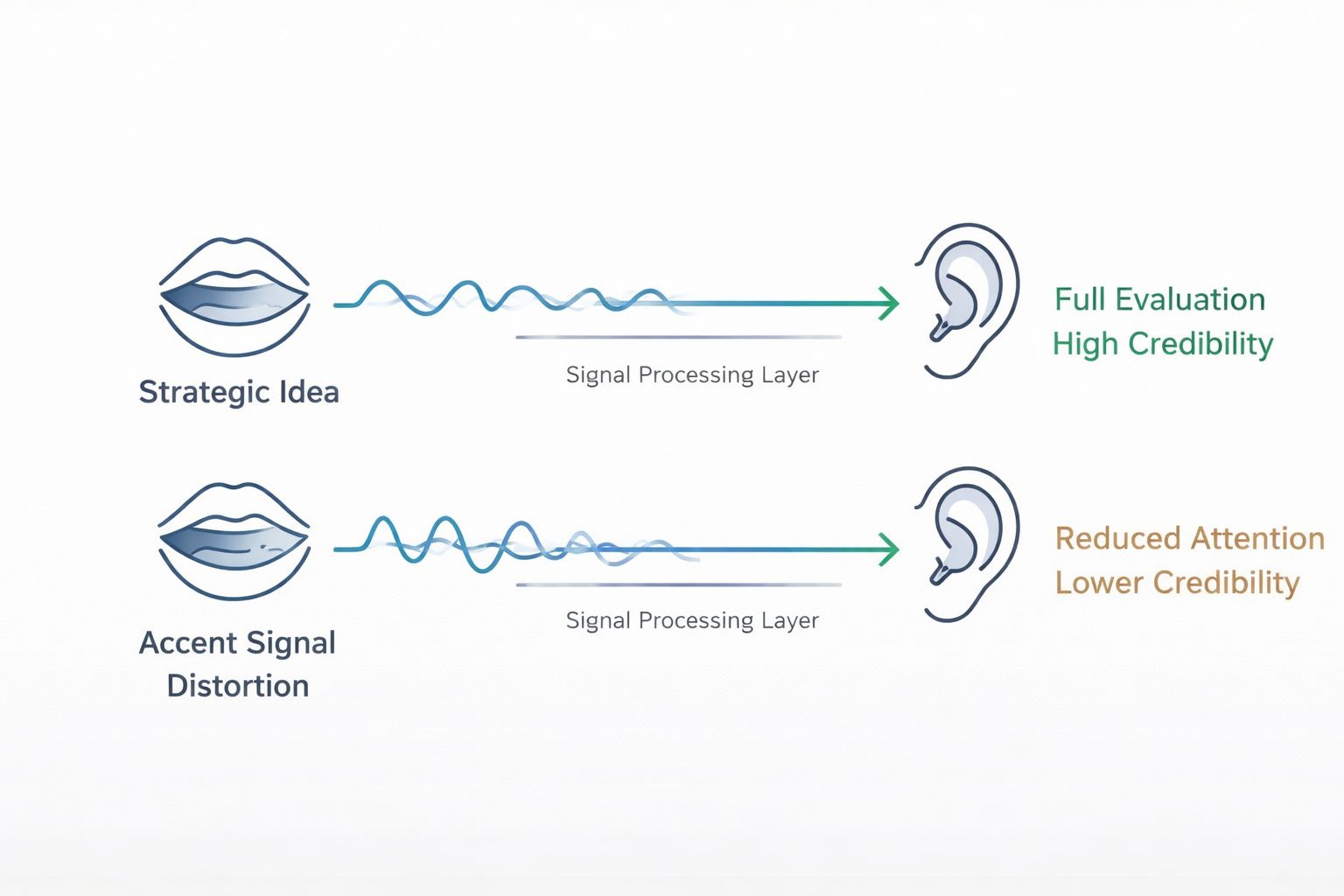
Accent Bias Operates as Automatic Credibility Filter
Non-native English speakers received measurably lower engagement across the analyzed TED Talks. The gap persisted after controlling for content quality, topic expertise, and platform visibility. Two speakers deliver identical ideas on equally prominent stages. One receives systematically less attention based solely on accent.
The filtering mechanism operates below conscious awareness.
Organizations recruited over 1,300 U.S. adults to evaluate identical content delivered with different accents. Credibility scores dropped for non-native speakers even when message content remained constant.
Decision-makers report evaluating ideas on merit while systematically discounting input based on accent patterns.
The organizational cost compounds across decision cycles. Strategic insights from non-native speakers fail to reach circulation velocity. Proposals stall in initial review stages before conscious assessment begins. Ideas never enter the consideration set for resource allocation.
The performance data reveals the dysfunction. Accent functions as an automatic credibility filter independent of content quality. The bias appears in hiring evaluations, performance reviews, and resource allocation decisions. Organizations claim meritocratic idea evaluation while operating filtering systems that exclude input before assessment occurs.
The Equation: Non-native accent ↑ = Automatic credibility ↓
Cognitive Resource Rationing Converts Accents Into Processing Capacity
Attention operates as a finite cognitive currency in organizational decision contexts.
Executives allocate processing capacity before evaluating content merit. The allocation mechanism responds to perceived authority signals, accent among them.
The controlled experiment recruited over 1,300 U.S. adults to evaluate identical creativity talks. Listeners assigned lower credibility scores to non-native speakers before content assessment occurred. Decision-makers ration cognitive resources based on accent. They process proposals with predetermined capacity limits.
Strategy reviews allocate 15-minute slots. Budget committees schedule 20-minute hearings. Cross-functional groups structure 30-minute briefings. Each forum operates under severe attention constraints where initial authority recognition determines processing depth.
The systematic dysfunction emerges through compounding cycles.
Non-native speakers trigger reduced initial credibility scores. Executives allocate minimal cognitive resources to their presentations. Proposals receive surface-level evaluation rather than deep analysis.
Ideas fail to advance not because insights lack merit, but because attention distribution protocols assigned insufficient processing capacity before evaluation started.
Organizations lose competitive intelligence by rationing cognitive resources based on accent patterns rather than strategic value.
Five protocols that eliminate accent as a credibility filter
1. The Documentation-First Evaluation Sequence
Strategic forums evaluate ideas through verbal presentation before written analysis. This sequence converts accent into a primary screening mechanism. Speakers face credibility thresholds before content receives consideration. Reversing the evaluation order eliminates the accent as an initial filter.
Require written proposals 72 hours before strategy meetings. All submissions follow identical templates with author identification removed. Executive teams score documentation before verbal presentations occur. Track proposal advancement rates quarterly, segmented by accent group. Publish disparity metrics to C-suite as an accountability mechanism. Measure whether documentation-first sequencing reduces advancement gaps between native and non-native English speakers across decision cycles.
2. The Speaking Time Equity Audit
Meeting participation patterns reveal systematic disadvantages operating invisibly. Attention functions as organizational currency, determining which proposals advance. Non-native speakers receive measurably less floor time at equivalent seniority levels. The gap compounds across decision cycles, excluding strategic talent from influence positions.
Install quarterly analysis measuring speaking time distribution, idea attribution in follow-up communications, and proposal advancement rates. Segment all metrics by accent group at identical title levels. Establish speaking time equity as a performance metric for executives running strategic forums. Distribute anonymized results quarterly with specific corrective targets for forums showing systematic disparities. Create executive accountability through bias audit results tied to leadership performance evaluations.
3. The Multi-Channel Submission Architecture
Digital platforms amplify accent bias through visible engagement metrics. Views and likes create measurable gaps compounding over time. High-performing ideas from non-native speakers receive less circulation despite equivalent merit. The visibility gap becomes a credibility gap. Organizations lose competitive advantage by systematically underweighting talent based on delivery characteristics rather than content quality.
Create three parallel submission channels: written briefs, recorded presentations, and live defense sessions. Contributors select the primary format based on communication strengths. Decision-makers review all formats before final evaluation. Track which channel produces the highest adoption rates, segmented by speaker accent group. Adjust organizational norms to favor channels minimizing bias while maintaining quality standards. Measure effectiveness through proposal advancement equity metrics across all three channels quarterly.
4. The Competence-Delivery Separation Standard
Performance systems conflate delivery style with strategic capability. Leaders apply higher credibility thresholds to non-native speakers before ideas receive consideration. The penalty operates independently of actual competence. Evaluation frameworks fail to distinguish accent from clarity, delivery mechanics from strategic insight.
Separate competence assessment from communication style evaluation in all performance reviews. Document specific evidence for both categories independently using distinct rubrics. Train evaluators to distinguish accent characteristics from content clarity through structured protocols. Implement written case analysis assessing problem-solving capability before verbal presentation in promotion decisions. Monitor promotion rates by accent group to identify systematic credibility threshold disparities requiring corrective intervention through revised evaluation standards.
5. The Rejection Rationale Documentation Protocol
Organizations assume meritocracy, while attention allocation follows invisible bias patterns. Two speakers deliver equally strong ideas yet receive meaningfully different engagement based solely on accent. Decision-makers lack accountability mechanisms, forcing explicit articulation of rejection rationale. Bias operates unchecked without documentation requirements.
Mandate written documentation explaining why specific proposals advance while others stall. Decision-makers articulate content-based rationale for idea rejection using structured templates. Review rejection patterns quarterly for systematic bias indicators across accent groups. Establish appeal mechanisms for proposals rejected without substantive content critique. Create executive accountability for maintaining attention allocation equity in strategic decision forums through quarterly bias audit results tied to leadership performance metrics and compensation decisions.
The 90-Day Assessment Reconstruction: Blind Evaluation or Permanent Input Filtering
Organizations face a 90-day decision window. Continue allowing a non-native accent to filter strategic input before content evaluation. Or implement assessment protocols that separate idea quality from speaker identity.
The old model assumes attention follows merit. The TED Talk analysis contradicts this assumption. Speakers with non-native English accents received systematically lower engagement across digital platforms, even after controlling for content quality, topic expertise, and visibility.
Two speakers deliver equally strong ideas on equally prominent stages. One receives meaningfully different attention solely because of accent characteristics.
The new model recognizes attention as organizational currency requiring active governance. Implement blind evaluation protocols for strategic proposals.
Require decision-makers to assess written ideas before speaker identity disclosure. Establish forums where input receives evaluation independent of delivery characteristics. The competitive positioning advantage belongs to organizations that neutralize this systematic attention filter.