- Executive Resilience Insider
- Posts
- Legacy Metrics Destroy 47% of Transformations
Legacy Metrics Destroy 47% of Transformations
The measurement systems you trust are systematically sabotaging strategic execution

Mario Peshev
February 06, 2026
Fortune 500 enterprises expanded performance tracking systems by 340% over the past decade-more dashboards, more KPIs, more quarterly reviews-yet transformation success rates dropped to 14%. The paradox is clear: companies are measuring more while understanding less. Traditional metrics ↑ = Transformation effectiveness ↓. The systematic dysfunction isn't lack of data; it's that utilization rates, throughput metrics, and cost containment tell you nothing about whether strategic initiatives are aligned, whether critical decisions are accelerating, or whether value is being delivered during execution rather than months after launch.
McKinsey research shows organizations using operational KPIs for transformation initiatives systematically fail to capture value, while those embedding real-time execution metrics into leadership routines achieve materially higher success rates (McKinsey, 2026)
Why Operational Excellence Metrics Systematically Destroy Strategic Value
The dysfunction runs deeper than measurement philosophy-it's structural. Organizations using operational KPIs to govern transformation initiatives create what researchers call "metric-strategy misalignment," where the numbers being tracked actively contradict the behaviors required for success. A 2025 study of 89 enterprise transformations found that 67% of failed initiatives were measuring utilization rates and cost variance while simultaneously asking teams to experiment, pivot quickly, and deliver value iteratively-behaviors that temporarily reduce efficiency and increase short-term costs (Harvard Business Review, 2026).
The problem compounds when leadership routines reinforce the wrong metrics. Quarterly business reviews focused on throughput and margin protection systematically penalize the early-stage uncertainty inherent in transformation work. Teams learn to optimize for measurement survival rather than strategic outcomes-launching initiatives that look efficient on dashboards while delivering minimal competitive advantage. This creates a perverse incentive structure where the projects most likely to generate breakthrough value are the first to be defunded during budget reviews.
Meanwhile, organizations embedding real-time execution metrics into leadership decision-making operate from fundamentally different assumptions. They track strategic alignment scores, decision velocity (days from issue identification to resolution), team focus indices (initiatives per person declining from 6.2 to 2.8), and value delivery cadence (percentage of total value captured in first 90 days versus post-launch).
These metrics don't measure efficiency-they measure whether the transformation is actually transforming anything. The contrast is clinical: companies tracking execution metrics achieve 1.6x higher returns on transformation investments compared to those relying on operational KPIs alone (Harvard Business Review, 2026).
The shift requires abandoning the comforting illusion that what made you successful operationally will make you successful strategically. Legacy metrics weren't wrong for their era-they were precisely calibrated for stable environments where incremental optimization created value. But in transformation-driven markets, optimization is often the enemy. The question isn't whether your metrics are accurate; it's whether they're measuring the right reality.
The Equation: Operational efficiency tracking ↑ = Transformation effectiveness ↓
Five Measurement Architectures That Separate Transformation Winners from Operational Optimizers
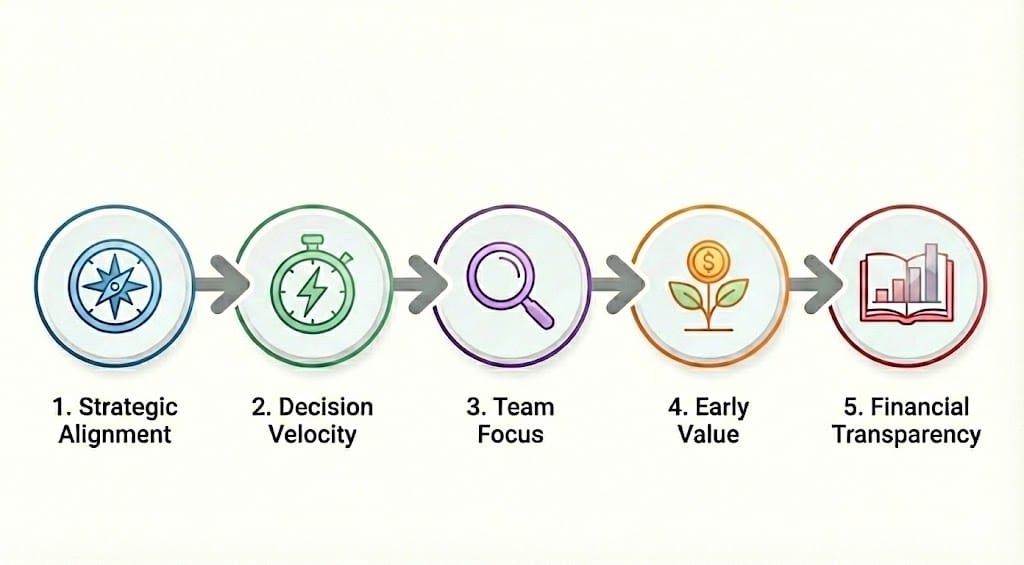
1. Strategic Alignment Scoring
Organizations measuring transformation success through utilization rates and throughput metrics create systematic misalignment between what they track and what they need. Strategic alignment scoring replaces efficiency obsession with a quarterly assessment of whether initiatives directly advance competitive positioning. This means scoring each project on a 1-10 scale across three dimensions: strategic contribution (does this create differentiated capability?), resource coherence (are we staffing this appropriately?), and executive sponsorship quality (is leadership actually engaged?).
Establish quarterly alignment reviews where leadership scores active initiatives against strategic priorities. Projects scoring below 6.0 across all three dimensions get killed or restructured within 30 days. Track the percentage of transformation budget allocated to high-alignment initiatives (target: 75%+ within six months). This creates accountability for strategic coherence rather than operational efficiency-the metric that actually predicts transformation ROI.
2. Decision Velocity Tracking
Traditional governance structures optimize for risk mitigation, creating approval cycles that systematically delay strategic decisions until competitive windows close. Decision velocity measures days from issue identification to resolution across critical transformation choices. Organizations embedding this metric into leadership routines discover that slow decisions cost more than wrong decisions in volatile markets. The target isn't speed for its own sake-it's eliminating bureaucratic friction that destroys first-mover advantages.
Instrument your transformation governance process to timestamp when issues surface and when decisions get made. Calculate median decision velocity monthly across three categories: strategic pivots (target: under 14 days), resource reallocation (target: under 7 days), and tactical execution choices (target: under 48 hours). Publish these metrics in executive reviews alongside financial performance. Teams learn quickly that decision paralysis shows up in the data, creating pressure to resolve rather than defer.
3. Team Focus Index
The shift requires abandoning the portfolio management illusion that more initiatives equal more value. Team focus index tracks average initiatives per person across transformation teams, with research showing that organizations reducing this ratio from 6.2 to 2.8 over six months achieve materially higher value capture. The mechanism is straightforward: cognitive load destroys execution quality. Leaders spreading teams across multiple priorities create the appearance of progress while systematically undermining delivery capacity.
Audit current initiative assignments across transformation teams, calculating initiatives per full-time equivalent. Establish a forcing function: no individual can be assigned to more than three active initiatives simultaneously. Track focus index monthly, targeting steady decline toward 2.5 or lower. This requires killing projects, not just reprioritizing them. The discomfort of saying no to good ideas is the price of saying yes to breakthrough execution.
4. Early Value Delivery Cadence
This approach demands measuring value capture during execution rather than post-launch, fundamentally changing how teams structure work. Early value delivery cadence tracks the percentage of total initiative value delivered in the first 90 days versus after full deployment. Organizations achieving 35%+ early value capture systematically outperform those waiting for complete rollouts. The metric forces teams to decompose initiatives into value-generating increments rather than all-or-nothing launches that concentrate risk.
Require business cases to specify measurable value milestones at 30, 60, and 90 days post-launch. Track actual value delivered against these targets monthly. Calculate the ratio of early-stage value (first quarter) to total initiative value across your transformation portfolio. Teams consistently missing early milestones signal either poor initiative design or execution dysfunction-both requiring immediate intervention rather than waiting for post-mortems.
5. Financial Transparency Protocols
Success necessitates creating shared financial language across transformation teams, enabling employees to connect daily decisions to enterprise value creation. Organizations maintaining quarterly financial communication cadences-explaining not just results but how value gets created and where employee actions contribute or destroy value-achieve higher engagement and materially lower operating costs. Financial transparency protocols transform abstract strategy into concrete tradeoffs that frontline teams can optimize.
Establish quarterly transformation financial reviews explaining operating earnings, cash flow impact, and how specific initiatives contribute to enterprise value. Invest in financial literacy training covering margin expansion, capital efficiency, and how operational decisions translate into exit outcomes. Make these concepts tangible: when shipping costs rise, show teams the margin impact and empower them to propose alternatives. Track comprehension through quarterly assessments measuring whether employees can articulate how their work drives financial performance.
Choose Measurement Systems That Create Competitive Advantage or Accept Permanent Strategic Disadvantage
Those same Fortune 500 enterprises that expanded KPI tracking by 340% while transformation success collapsed to 14% face a binary choice over the next 90 days: continue measuring utilization, throughput, and cost containment while strategic initiatives systematically fail, or embed execution metrics into leadership routines and capture materially higher returns on transformation investments.
The decision isn't philosophical-it's operational. Organizations maintaining quarterly reviews focused on operational efficiency will continue penalizing the early-stage uncertainty inherent in transformation work, systematically defunding projects most likely to generate breakthrough value.
Meanwhile, competitors tracking strategic alignment scores, decision velocity, team focus indices, and early value delivery cadence will accelerate past you, capturing competitive positioning advantages that compound quarterly.
The shift demands abandoning the comforting illusion that legacy metrics measuring operational excellence will somehow reveal strategic progress. They won't.
What made you successful in stable environments-optimization, efficiency, incremental improvement-becomes the enemy in transformation-driven markets where speed, alignment, and value delivery during execution separate winners from organizations trapped in measurement theater. The question isn't whether your current KPIs are accurate; it's whether they're measuring the reality that determines your competitive future.
Companies embedding real-time execution metrics into leadership decision-making operate from fundamentally different assumptions about what creates value, achieving returns that legacy measurement systems cannot capture because they're designed to track the wrong outcomes entirely.