- Executive Resilience Insider
- Posts
- 70% of innovation projects die during handoffs
70% of innovation projects die during handoffs
Linda Hill's research reveals the hidden leadership gap destroying breakthrough ideas

Mario Peshev
January 30, 2026
When innovation partnerships collapse, most executives blame organizational bureaucracy. Difficult teams. Resource limitations. They pursue structural solutions—better governance, more formal coordination, clearer accountability frameworks.
Companies that break through do something different.
They identify potential bridgers already working successfully at boundaries. Place them in innovation leadership roles. Give them authority to curate partners based on commitment potential, not just capability mapping. Empower them to translate across technical and business languages. Support them as they build operating models that partners co-create rather than accept.
The transformation shows up in metrics. First-time-right delivery rates jump from 65% to over 80%. Decision velocity accelerates—hourlong presentations become efficient exchanges. Innovation project success rates climb from 25% to 90%. Market cap growth follows execution capability.
The choice: Developing bridger capabilities requires equivalent resources as implementing formal partnership structures—simply allocated toward emotional intelligence rather than governance sophistication.
Organizations implementing bridger systems consistently outperform traditional competitors. The performance differential is measurable: 90% versus 25% breakthrough success rates, 40% faster launches, 3.95 times higher revenue.
Companies identifying and developing bridgers within the next 90 days establish competitive advantages that traditional structures cannot replicate.
The implementation window closes as innovation-velocity leaders establish positioning advantages. The consequences are permanent.
When you address collaboration execution capability instead of structure sophistication, everything changes.
Why Innovation Partnerships Collapse
A promising product prototype tests brilliantly with customers. The team works tirelessly for three months, validates everything, and proudly hands the innovation to IT and marketing for implementation.
Within weeks, the initiative is dying.
IT can't integrate the advanced technology stack with legacy systems. Marketing doesn't know how to reach the unfamiliar customer segment. Leadership worries the innovation is too incremental for a rapidly evolving market. What looks like a technology problem is actually something else entirely: the partnerships meant to deliver the breakthrough are collapsing.
Linda Hill has watched this pattern repeat for decades across hundreds of companies. 83% of digitally mature organizations implement cross-functional teams. Companies invest heavily in formal partnership structures—dedicated project managers, innovation labs, governance contracts. Yet 70-95% of innovation projects still fail during handoffs, wasting investments while competitors capture markets.
The gap is measurable. Organizations deploying bridgers—leaders with emotional and contextual intelligence who curate partners, translate across boundaries, and integrate disparate efforts—scale breakthrough ideas at 90% success rates. Traditional partnership structures deliver 25% success rates. The difference isn't investment level. It's execution capability.
Mastercard's market cap exploded from $6 billion to $390 billion when Garry Lyons built Labs and translated emerging technologies into language board members could grasp. Delta became the first major airline to headline the Consumer Electronics Show when Nicole Jones built The Hangar and reframed IT teams as innovation partners rather than service providers. DIFC Fintech Hive got direct competitors openly sharing strategy at the same table when Raja Al Mazrouei spent months listening to what kept executives up at night.
Companies have 90 days to identify and develop bridger capabilities or watch competitors execute the partnerships they can't.
The Partnership Paradox Nobody Discusses
Linda Hill has watched this pattern for decades. After studying hundreds of innovation initiatives, she identified an uncomfortable truth: over 90% of innovation projects end in failure, never generating any benefit for the company.
The cause isn't flawed ideas.
Companies with promising prototypes watch initiatives collapse at a predictable stage: when projects transfer to business units for large-scale launch. Hill calls it the handoff problem. Organizations invest in formal coordination mechanisms while missing what actually drives collaborative success.
Partners can't collaborate across boundaries because structural solutions don't create the social connection required to build trust. You can't mandate trust through governance contracts.
The evidence is stark. Companies engaging in external collaborations increase revenue by 3.95 times compared with firms that don't. Yet 75% of innovation failures stem from poor alignment between solutions and market needs—not because alignment is impossible, but because partners can't translate across their different priorities.
"Organizations must 'partner or die,'" Hill explains, "but sharing the driver's seat is difficult. The more that innovation relies on collaboration across groups and firms, the more initiatives stall because the partnerships meant to deliver them break down."
While executives pursue formal mechanisms, competitors with bridger capabilities are advancing.
What Bridgers Do Differently
Garry Lyons walked into a Mastercard board meeting carrying a smart watch and a digital vending machine prototype. Most executives didn't understand blockchain or tokenization—abstract technical concepts, impressive on paper but meaningless for strategy.
One board member later admitted what he'd been thinking during earlier technical presentations: "I nodded along. Asked what I thought were smart questions. But I had no idea what we were approving. I was terrified someone would realize I didn't understand, so I just... agreed."
Lyons didn't present slides. He demonstrated.
Put the watch on board members' wrists. Walked them through purchasing from the vending machine. Made the future of transactions tangible instead of theoretical. Board members who moments earlier struggled with terminology suddenly understood exactly how customers would interact with these technologies.
Three months later, that same executive championed the acquisition that became Mastercard's largest digital bet.
That's the performance differential bridgers create. Organizations with bridger leadership succeed in breakthrough innovation 90% of the time, whereas traditional structures deliver 25% success rates. Best-performing business units maintain 24% failure rates while competitors experience 46% failure rates.
After Lyons spent months translating emerging technologies into business language, Mastercard's acquisition decisions shifted from hourlong presentations to efficient exchanges. Revenue streams from new products drove market cap growth from $6 billion to $390 billion.
Bridger capability × Partner curation × Translation × Integration = Innovation velocity
Organizations without this multiplication watch promising initiatives collapse. Traditional competitors pursuing formal mechanisms fall further behind.
The Three Functions Bridgers Master
Linda Hill's research, published in Harvard Business Review and detailed in Genius at Scale, identifies how bridgers actually work.
Bridgers perform three functions: curating partners, translating across boundaries, and integrating disparate efforts. Not sequential steps—fluid activities that build relationships creating conditions for partners to take risks together.
Nicole Jones faced this challenge building Delta's The Hangar. She needed to develop a biometric boarding pass in 90 days, requiring coordination across Clear Secure, Delta IT, TSA, and U.S. Customs.
Delta's IT team kept missing deadlines. When Jones investigated, she discovered the real problem: deep-seated fear. These engineers had survived a costly tech outage. System uptime was their single priority. Opening their systems to a startup felt terrifying.
Jones didn't escalate. She sat with them. Listened. Then reframed the entire project.
Instead of IT as service providers, she cast them as partners shaping innovation. She showed how system uptime was fundamental to exceptional customer experience. IT wasn't blocking innovation. They were protecting the foundation innovation required.
The Hangar exceeded goals, conducting over 30 explorations and scaling several solutions.
That's bridger leadership: building trust through understanding what people actually care about.
Framework 1: The Partner Curation System
Raja Al Mazrouei needed to get natural enemies working together.
She was launching DIFC Fintech Hive, an accelerator bringing fintech startups to Dubai. The vision required three groups collaborating: financial institutions, startups, and regulatory bodies. The problem? They viewed each other as existential threats.
Al Mazrouei spent months conducting one-on-one meetings with C-suite executives at over 20 financial institutions. She listened for common threads in their challenges. Shared proprietary benchmarking studies showing how fintech was reshaping global markets. Documented not just what each potential partner could contribute, but what mattered to them personally—their fears about disruption, their motivations, their risk appetite.
The shift executives miss: Partner selection isn't administrative team assembly. It's strategic capability mapping focused on building commitment before projects launch.
Implementation: Weekly network mapping identifies who possesses required capabilities. Monthly partner assessments evaluate alignment on goals and risk tolerance. Bi-weekly one-on-one conversations discover friction points early. Track engagement through commitment scores (1-10), not meeting attendance.
When Al Mazrouei launched, 11 startups joined the inaugural program, selected by competing financial institutions now openly sharing strategy at the same table.
Framework 2: The Translation Protocol
The Mastercard board member stared at the technical documentation, clearly lost. Garry Lyons could see it—that polite nodding that means confusion. This was a brilliant strategist who'd built companies and understood markets. But blockchain? Tokenization? Foreign concepts wrapped in jargon.
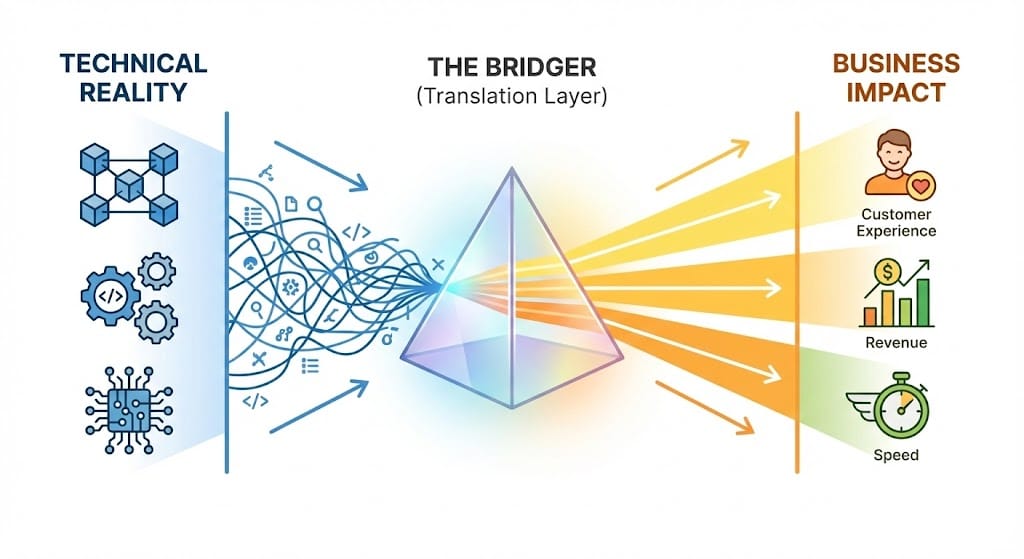
Most innovation leaders would have pushed harder on technical explanation. Lyons did something different.
He stopped talking and started demonstrating. Put a smart watch on the executive's wrist. Walked them through purchasing from a digital vending machine. Suddenly the abstract became concrete. The executive wasn't learning about blockchain—they were experiencing the future of customer transactions.
Richard Haythornthwaite, Mastercard's board chair, later explained that Lyons never made nontechnical leaders feel like "second-class citizens." When executives hesitated asking questions in groups, Lyons spent one-on-one time personalizing explanations without talking down.
The translation gap: Technical experts assume shared goals create shared understanding. They don't. Partners need possibilities framed in their language and aligned with their priorities.
Implementation: Daily pre-meeting preparation identifies each stakeholder's context—performance metrics, values, constraints. Create stakeholder profiles and translation templates converting technical specifications into business impact statements. Monthly perspective-sharing sessions where partners explain their challenges to others.
Track through decision velocity. At Mastercard, acquisition decisions shifted from hourlong presentations to efficient exchanges.
Framework 3: The Integration Architecture
Nicole Jones watched another meeting devolve into debate. Delta's IT team and Clear Secure kept talking past each other. IT focused on system reliability. Clear prioritized feature velocity. Marketing needed customer experience clarity. Everyone had valid points. Nobody was aligned on what success actually meant.
She called a stop.
Jones created what her team called the "Initiative Canvas"—a simple form forcing brutal honesty about fundamentals. Not aspirational vision. Actual agreements on deliverables, decision rights, success criteria. The most valuable field: "Whom we want to wow with this solution."
That question changed everything.
IT realized their excellence in system uptime was fundamental to wowing customers. Clear understood their biometric speed meant nothing if IT couldn't handle integration reliably. Marketing saw how both priorities aligned with exceptional customer experience.
The form captured potential skeptics by name. Identified who had actual decision authority. Defined explicit handoff protocols. Established shared metrics everyone would be measured on together.
What organizations miss: Partner alignment on goals doesn't translate to aligned execution. You need explicit operating models.
Implementation: Weekly integration sessions where partners co-create division of labor. Shared north star statements linking priorities to collective ambition. Decision frameworks like "DFV" (Desirability, Feasibility, Viability) for joint investment calls.
The Hangar's first-time-right delivery jumped from 65% to over 80%.
Framework 4: The Trust Acceleration Method
Delta's IT engineers started staying late. Volunteering solutions. Defending the project in meetings with their managers. What changed? Nicole Jones had done something most innovation leaders won't: she'd admitted uncertainty.
"I don't have all the answers here."
When Jones said this, you could see the shift in the room. These were engineers who'd been burned before—told what to do by innovation teams who didn't understand their constraints, blamed when implementations failed.
Jones acknowledged the legitimate fears IT had about system stability. Made it clear she needed their expertise to shape the project, not just execute her vision.
Then she went further.
In weekly sessions, she gave IT real decision authority—not advisory input disguised as empowerment, but actual control over integration approach and timing. When they raised concerns about system load, she didn't override them. She worked with Clear to adjust architecture based on IT's operational knowledge. Engineers invested in the outcome because they owned it.
That's how trust accelerates. Not through team-building exercises, but through demonstrated vulnerability and genuine shared authority.
The fundamental mistake: Organizations think formal structures create trust. They don't. Partners won't take risks with people who won't acknowledge uncertainty or share real power.
Implementation: Weekly vulnerability sessions where leaders acknowledge knowledge gaps. Decision protocols giving partners actual authority. Monthly check-ins during setbacks reinforcing shared intention. Track willingness to share sensitive information, challenge assumptions, invest discretionary effort.
Measure through sustained engagement during failures, not participation during success.
Framework 5: The Bridger Development Pipeline
Nicole Jones didn't start at Delta's innovation lab. She spent years rotating through seemingly disconnected roles—digital content strategy, marketing optimization, retail strategy. Each rotation felt lateral, sometimes backward. Colleagues who stayed in single functions advanced faster.
But Jones was accumulating something more valuable than hierarchical position: she was learning how different parts of Delta actually worked. How decisions got made in marketing versus operations. What metrics drove different teams. The unspoken rules governing each function. When she took charge of The Hangar, she understood Delta holistically in ways single-function leaders couldn't.
Outside work, she participated in Atlanta's startup community—exposure to different operating models and power dynamics that taught her to work across boundaries.
That's how bridgers develop. Not through leadership training programs, but through deliberately zigzagging across functions and contexts.
What organizations miss: They promote people up functional silos, then wonder why senior leaders can't collaborate across boundaries. Bridging capability develops through boundary-spanning experience.
Implementation: Identify people already working successfully at boundaries—assembling cross-functional teams, building senior networks. Place them in roles requiring work across functions or geographies. Establish rotation programs. Provide executive air cover when they face competing departmental pressures.
Track bridger retention rates and innovation project success rates with bridger leadership versus traditional management.